

Photo: Berta Jänes
New Exhibition Chronicles the Story of Textile Dyes from Ancient Times to Today
Monday, 19. jan 2026
Open from the 17th of January
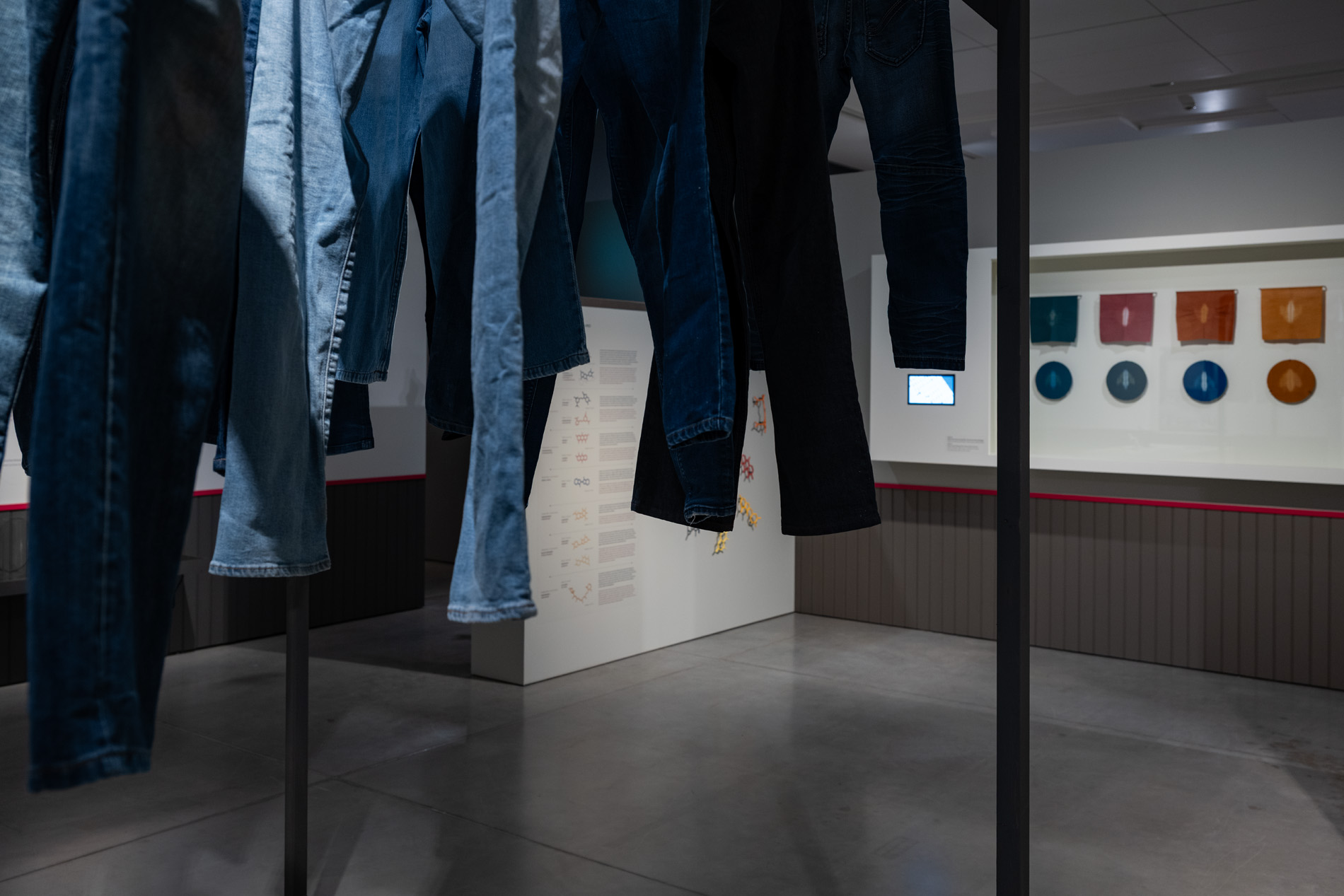
The Estonian National Museum opened a new exhibition “The Colours of Our Clothes. The Local and the Global” in its gallery on the 17th of January 2026. The Exhibition explores the history of natural dyes and the dye trade through contemporary scientific research, while drawing attention to the environmental impact of the textile industry and how the use of natural dyes could help mitigate it.“This is the first time historical textile dyes are presented with this level of depth in an Estonian exhibition,” says ENM Junior Researcher Liis Luhamaa, one of the exhibition curators. Visitors will learn about both local natural materials and distant trade routes that enabled people here to achieve new colors in their clothing. “The exhibition also showcases the work of scientists and designers who drew inspiration from ancient colors as they search for more environmentally friendly methods of dyeing textiles,” Luhamaa notes, referring to the ecological impact of modern synthetic fabric dyes.
Behind the vibrant stripes and colorful embroidery of Estonian folk costumes lies a long history of dye trade. Red and blue hues arrived here along the same trade routes that brought spices, textiles, and other goods to Estonia, weaving together local craftsmanship and distant dyestuffs—from Asian indigo to South American cochineal.
“Locally, however, reddish tones were obtained from rotted alder buckthorn and common alder bark as well as bedstraw roots,,” says exhibition curator Liisi Jääts. She notes that old dyeing techniques were quite specific and some of this knowledge has been lost over time. “The research took us both into the archives as well as into the laboratory,” Jääts adds.
The exhibition presents research findings from the international European Union supported “Colour4CRAFTS” project, which brings together experts from research institutions and development companies investigating natural textile dyeing from a historical perspective, combining it with novel bio-based dyes and waterless technology. One of the project’s goals is to offer a viable alternative to synthetic fabric dyes. “The textile industry is considered one of the most polluting industries, using vast amounts of water and contaminating the environment. More environmentally friendly dyes and dyeing technologies would be an important breakthrough,” says exhibition curator and researcher Kerttu Palginõmm.
The exhibition displays historical garments from the Estonian National Museum’s collections as well as archaeological finds and reconstructions. Visitors will also find yarn and fabric samples dyed for the exhibition according to recipes discovered in archives, compared with objects from the museum’s collection. The exhibition allows visitors to explore historical instructions for gathering plants and dyeing with them. Videos provide an overview of both historical dyeing methods and innovative techniques.
The exhibition opened in the Estonian National Museum’s gallery on January 17, 2026.
The Estonian National Museum is an ethnologically oriented cultural history museum dedicated to reflecting everyday life and culture as ways of living, across temporal, spatial, and social contexts. Based in Tartu, the museum focuses on Estonian culture alongside other Finno-Ugric peoples. The Estonian National Museum serves as one of Estonia’s principal centers for ethnological research and teaching. The museum has received numerous international recognitions, including the prestigious Kenneth Hudson Award from the European Museum Forum.
Curators: Liis Luhamaa, Liisi Jääts, Kerttu Palginõmm, Age Raudsepp, Ellen Värv, Riina Rammo
Producer: Reet Mark
Designer: Mae Kivilo